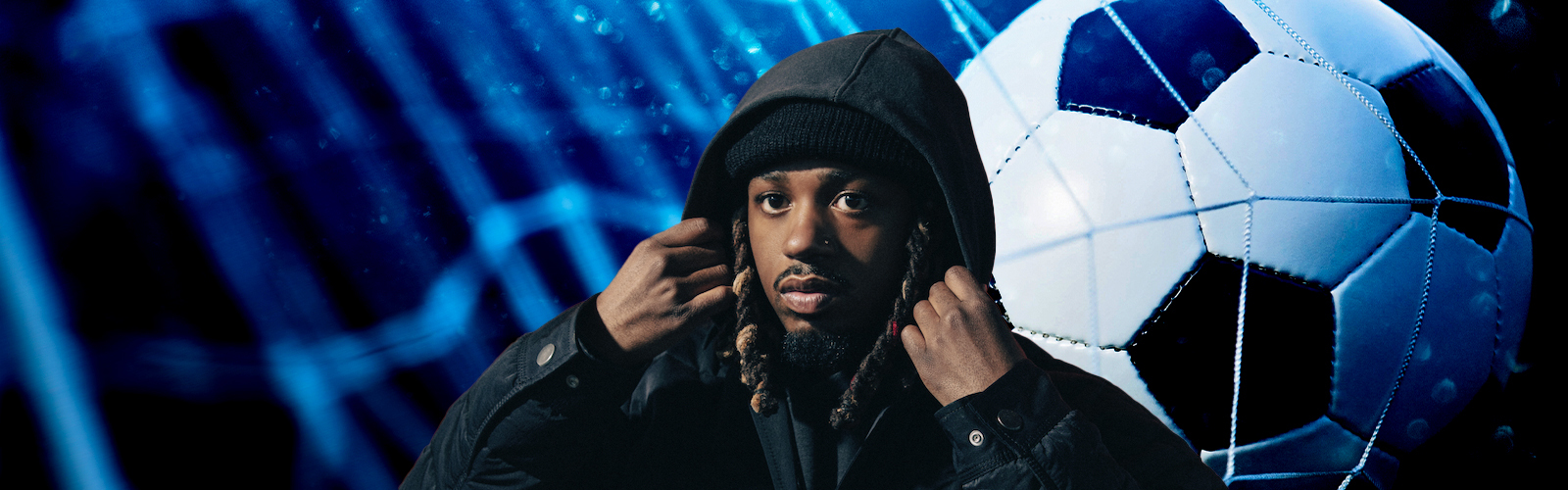
You might be forgiven for not knowing that hip-hop superproducer Metro Boomin claims St. Louis as his hometown. After all, thanks to his work with trap rap mainstays like 21 Savage, Future, Migos, and Young Thug, his looming, thunderous instrumentals have become the de facto sound of Atlanta. But although he’s made his mark in the Peach State, he still counts the Show Me State as home.
And now that St. Louis has added a sports team, the St. Louis City SC, he’s all-in on showing his support — even if he’s never been the biggest soccer fan. The club is kicking off its inaugural home game with the “CITY Block Party” at the CITYPARK stadium Friday, March 3 at 6 pm CST and Saturday, March 4, headlined by Metro Boomin with a special DJ set from Anderson .Paak as DJ Pee .Wee (they’ll be supported by local acts Mvstermind, Kennedy Holmes, and DJ Mahf).
Metro was kind enough to check in with Uproxx via Zoom to talk about the sound of St. Louis, his connection to his hometown, the cross-regional impact of his music, and of course, his burgeoning soccer fandom. We also fell down an anime rabbit hole and talked about ASAP Rocky’s upcoming album Don’t Be Dumb, which Metro contributed to so heavily that the Harlem rapper nicknamed the album Flacko Boomin.
For more details about the CITY Block Party, check out the St. Louis City SC website.
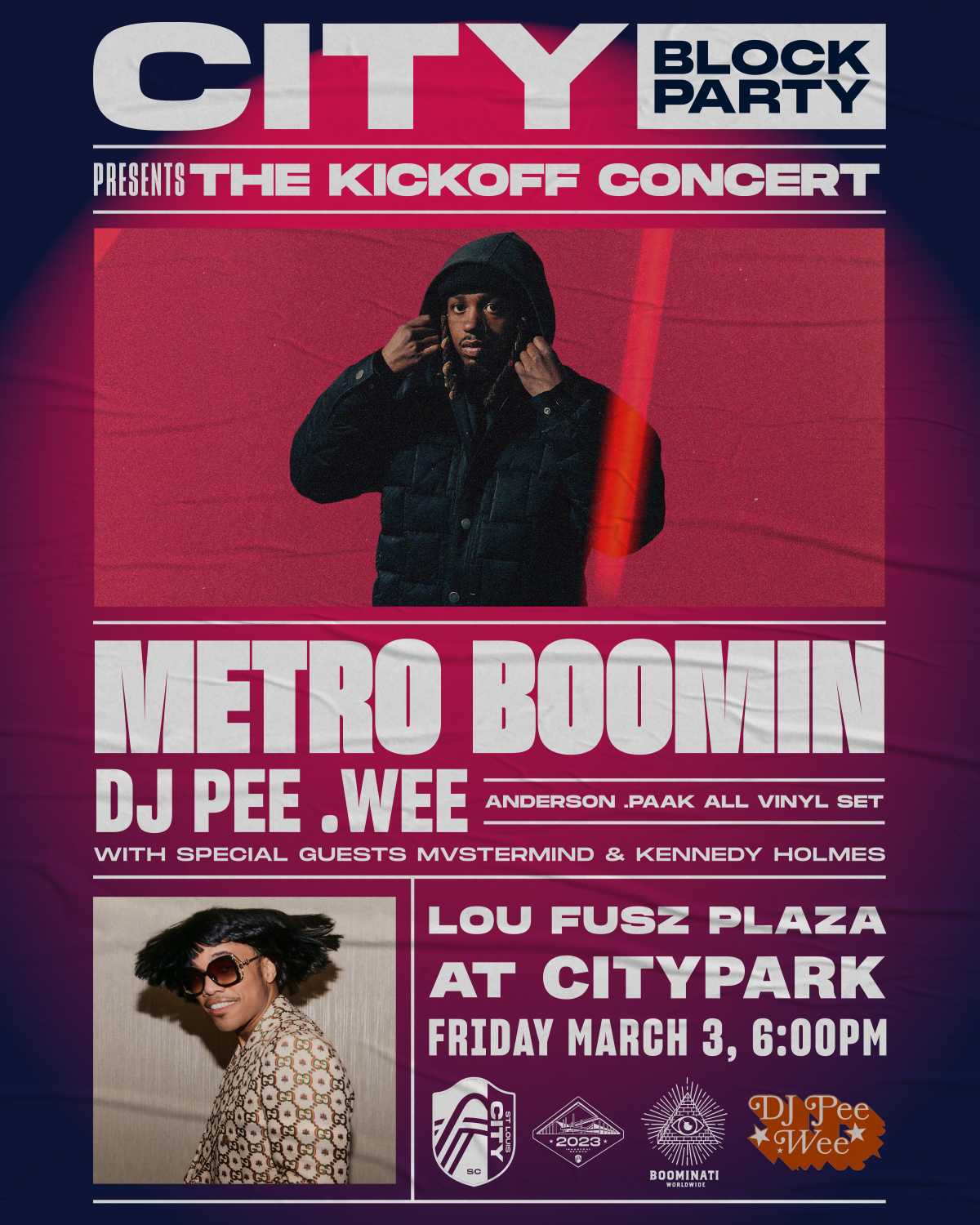
How’d you get involved with the City Block Party and what made you say yes to kicking off the St. Louis City SC season?
Because of St. Louis, more than anything, me being born and raised there and always looking for great opportunities and the right opportunities to bring awareness and shine more light on the city. Definitely excited to be a part of this. This is big. This is historic. St. Louis getting a soccer club, that’s major. I’m just grateful that they even reached out and I jumped at the opportunity.
Yeah, yeah, I understand. Anything Compton-related, I’m on it. Were you a big fan of soccer growing up at all? And if so, who was your team?
Actually, no, I was a fan of soccer, but I just always been such a fan of St. Louis and I still am. But I actually started going to some soccer games a few years ago. It was just a new experience and I remember after the first one I just kept going because it was just a different kind of excitement — just the fact that you know how most games, there’s pauses in between play? It’s just nonstop. That was new for me and really just piqued my interest and opened my eye up to that world.
Now that St. Louis has its own team, are you going to get season tickets?
Man, hopefully. Hopefully, man, I don’t want it to be a one-and-done thing. I definitely plan on just getting as involved with the club as I can.
And of course, another name for soccer is football. We know our Super Bowl just passed. Were you rooting for the Kansas City Chiefs?
Yeah. Even though it’s not the Rams (Metro roots for the Los Angeles team), it was still Missouri. I had to go with that over Philadelphia. It’s still like, Show Me State.
Yes, sir. Speaking of St. Louis, I wanted to ask you about how St. Louis has figured into your music, but it occurred to me that for someone my age if you say, St. Louis, we’re going to think of Nelly, St. Lunatics, and Chingy, but when people hear Metro Boomin, a lot of times I think they may associate that with Atlanta, like Migos, Future. How do you reconcile that in your music?
That’s one of the main reasons I jumped at this opportunity and why I wear a Cardinals hat all the time: Just to remind people, you know what I’m saying? I’m born and raised in St. Louis, Missouri. Atlanta is my second home. I moved there at a young enough age that I grew up there as a man, but I went to school in St. Louis.
And as far as the music, even though I worked with a lot of artists, a lot of my come-up was with a lot of prominent Atlanta artists and aiding their come-ups as well… I’m all automatically in the Atlanta conversation, but I feel like just how I was doing that with the Atlanta artists, the next step for me is just bringing and shining a light on St. Louis talent because there’s just so much of it. It’s so much raw talent. That’s one of my next goals for sure.
What would you say is the thing that sets St. Louis apart from most other cities in terms of the sound musically? Right now, you guys have Smino who’s very spacey, like Parliament-Funkadelic almost. Whereas for yourself, you have the trap, 808 thing. Does the city have a signature sound? And if so, what is it?
Man, St. Louis’s signature sound is, more than anything, soul. We put feel in. It’s no gimmicks in our music. Everyone always talks to me about my production, just how dynamic [it is] and just the ranges of where it can go. And I feel like that comes from just growing up in St. Louis. Traditionally in hip-hop, it’s like, okay, you got the South, you got the West Coast and the East Coast, mostly the West Coast and the East Coast.
But man, growing up in the Midwest, it’s like we was catching all the East Coast, the West Coast, the South. I grew up listening to Tupac, but at the same time, Cameron, Dipset, Outkast, Eminem, just from everywhere. Back then, people on the East Coast was really just listening to East Coast rap. People on the West was really listening to West Coast and so forth. But through the way music traveled, I feel in the middle, we was just catching everything. And I feel like that has a big impact on my sound as well as just everybody in St. Louis because we all come up just listening to everything.
I know you do a lot of interviews. I do a lot of interviews. We both get sick of hearing and asking and answering the same type of questions over and over again. If you were going to ask yourself a question for an interview, what would it be? What’s something you always wanted to talk about but never had the chance to?
Damn, that’s a good one. I ain’t going to lie. I got a lot of respect for that question. That’s a good one. That’s the first time I got that one. Something I always wanted to be asked. Ooh, damn, I’m trying to think of something good.
Well, I’ve had people tell me about all kinds of things. Anime, sports, sneakers, clothes, all of it.
As far as anime, I just got into that in the past year.
Oh, really? Cool. What you been watching?
My introduction was One Punch Man. I just fell in love with that. It just became a theme for me. And in the process of watching that while I was working on Heroes And Villains, someone had told me, they was like, “Man, you need to watch My Hero Academia.” I had started that. And then as I was finishing the album, I didn’t have that much time, but my little brother, he’s eight, he ended up flying through the season, and now he’s on season six. I’ve been binging it for the past couple of months, and I just caught up to season five today on the plane. I got to season five, and I’ve been loving that show. I ain’t going to lie, I’ve been watching that a whole lot. I started Attack on Titan, I got to get back on it, and somebody told me to watch Death Note. I’m supposed to watch that too.
Those influences are strong. May it give you lots of inspiration for your next project.
Nah, without a doubt. It gave me a lot of inspiration, even on the last one, just on the morality and the duality of just Heroes And Villains, and just even watching that stuff every day, it put a lot of stuff in perspective on the point I was trying to get across with the album.
You are a truly groundbreaking producer in your own right. And for me, one of the most groundbreaking producers of my generation was De La Soul. Are you looking forward to De La Soul hitting streaming tomorrow? And if so, which project are you streaming first and why?
Well thank you, I appreciate that. De La Soul? They hitting streaming tomorrow?
Yes, sir. For the first time ever in the whole history of streaming.
Damn, that’s crazy. It’s crazy that if you really think about it, it’s really a bunch of stuff that’s not on streaming, that growing up, it was so regular. I was always so big on a lot of the Death Row albums.
I would probably say, what’s that one? … I was in fourth grade, sixth grade. I remember it had the cover with the blue. It was a calendar. What was that?
Yeah, The Grind Date. I really recommend that one. That one’s really tight. That one’s actually not part of their original deal so it was actually already on streaming, you can check that one out now if you want to.
Meanwhile, ASAP Rocky is jokingly calling his next tape Flacko Boomin, which I think is really clever, but it also highlights how closely you’ve been working together. Are you able to reveal any details of that project ahead of time?
Man, it’s crazy. I was talking to Flacko yesterday. I wish people really knew the details of our history and just our brotherhood over time, between me and him, and linking with him through Yams back in high school when I was in St. Louis still. That’s how I first linked with them. I just feel like right now it’s just an accumulation of everything lining up for us to finally just do our joint. We always do so many songs and I feel like we just done got used to just them stashing and piling up and not putting them out. But what can I say, man, you got to stay tuned. I promise we won’t waste your time.
source https://uproxx.com/music/metro-boomin-interview-st-louis-city-sc-block-party/
Comments
Post a Comment