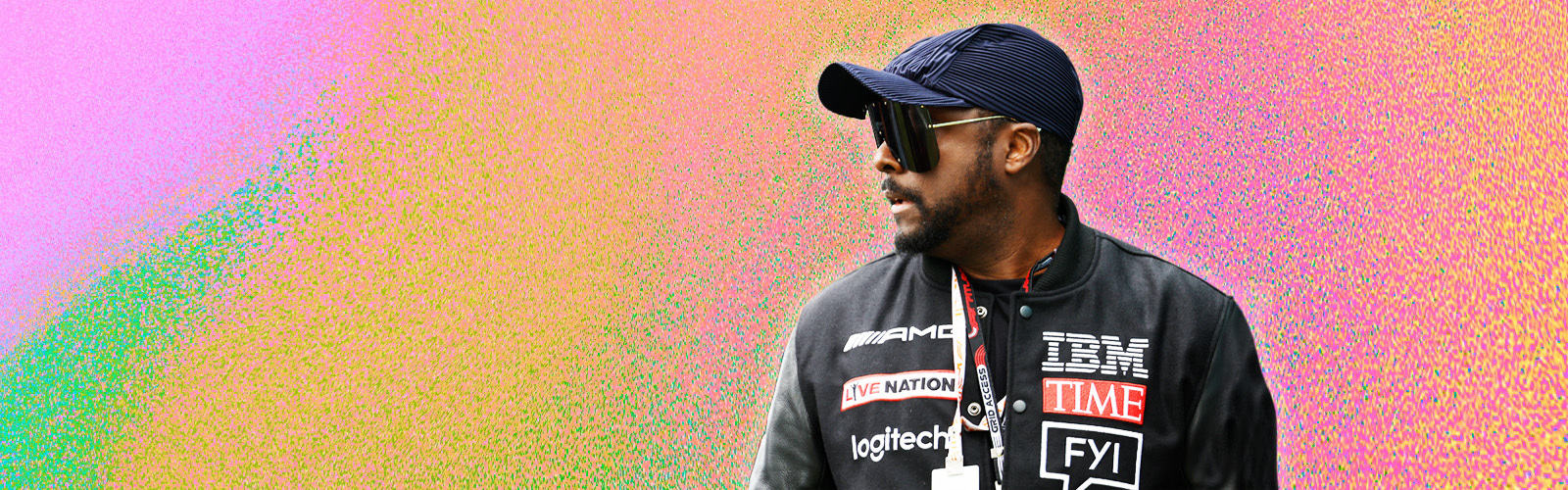
MIAMI – will.i.am needs to eat. He’s been pulled into TV live hits, quick meetings, meet and greets, and plenty of selfies, and he hasn’t had time to sit down to collect his thoughts. He puts an order in at the Mercedes compound in the team village and should have just enough time to enjoy that before heading out to the track for driver intros and a chance to showcase his new track, “The Formula” with Lil Wayne, marking a pivot for F1 that feels almost two decades coming.
While those driver intros — much more NBA All-Star Weekend than traditional motorsports — still are taking a little bit of getting used to, it’s the culmination of something will.i.am has seen as the future of F1 since his first in-person race experience in Singapore in 2008. F1 is hitting its stride in the States, which means more American-style pageantry and a general shift toward personalities that took a huge step forward in large part thanks to Netflix’s Drive To Survive series. As Max Verstappen (who ran a perfect race, starting near the back due to a fluky qualifying session on Saturday, but still managed to pass fellow Red Bull driver Sergio Pérez to win the Miami GP) mentioned during a short Q+A in Heineken’s Paddock Club, he often can’t do much more than go from training or track to hotel and back. Going out to dinner is a challenge now.
But all the drivers, despite the frustration, would agree this is ultimately good for the sport, and the opportunities to do more and more off-track have them reaching superstar status usually reserved for Oscar winners and first-name footballers.
There’s still more room for F1 to enter and disrupt the zeitgeist, and that’s where will.i.am comes in. As artist in residence for the sport, “The Formula” is just one component, and he sees chances to drop not just more songs into the mix, but add his cultural expertise and futurist perspective. It’s a project that seems uniquely suited for will, who has made his career on being not just in the moment, but creating the next moment in the studio, in business, in AI, and elsewhere.
UPROXX Sports had a chance to speak with will.i.am about the road to working with F1, where the sport can go moving forward, and what’s next.
Martin Rickman: How did the F1 opportunity come about for you?
will.i.am: There’s some opportunities that come to you, and then there’s opportunities that you materialize. So I had the idea to connect dots that people didn’t see, and those dots that people didn’t see are that F1 has amazing events that happen before the race. Friday’s crazy and the night is amazing, no matter what city you go to. Friday is the practice run. The party on Friday night is always the best. Saturday is qualifying. The party on Saturday is insane. Sunday is the race, and it’s like a moving freaking festival circus in the form of a race. But what the people see when it’s broadcast is just the race.
Just the race.
They don’t see the arts and the culture that’s happening in and around the races. And they fly artists out to perform at these parties, the local promoters. But that’s not captured in the broadcast.
No. That’s just for the people who are able to be at those.
Right. So I was like, “Hey, why don’t we do like an artist residency concept where one of the artists gets selected, they make an album, they release singles around key locations and videos?” In this case, me and Lil Wayne for the Formula. Me and J Balvin for a song that’s going to come out in the next couple of months. And then an album right around the end of the season in Vegas. And then the last song and video for Abu Dhabi in the race. And you repeat next year. And I pitched this concept to F1 CEO Stefano [Domenicali]. I attend the Harvard Business School. He was speaking. So I flew out to Mexico. He’s like, “Oh, I have to go to Boston and I’m speaking at Harvard.” I’m like, “I go to Harvard.”
You’re here right now.
And so he’s like, “Well, let’s meet up.” I was like, “Okay.” So from Mexico flying back to Boston is when I was like, “Whoa, I’m going to pitch him an amazing idea. Let me get this idea in order.” So I pitched him the vision at Harvard Business School.
Amazing. And so obviously he was into it, and then it led to it actually happening. Because nothing happens overnight. You work on things for years sometimes to make these things happen.
So it took from November the second until — here we are, May 5, May 8 — to get everything and the deal done, make the songs, shoot the video, record the orchestra, film the orchestra, film the video, film the part of this video for “The Formula” on the Saudi track. And all the activities, all the organizing strategy, finalizing on notes and edits all happened on FYI.
And for people who aren’t familiar yet with FYI, the app that you’ve been developing for the past three years, was this a good pilot opportunity for you to utilize the project, kind of in real-time, and then be able to continue to test everything that you had been working on?
So the first pilot, we knew the power of it by working with ITV, to do The Voice this year. And Mercedes, I worked with Mercedes very closely, the car that I made last year that I launched here [in Miami], we used the product for that. So we’ve stress-tested it and put it to work. But this is the first time it’s at this scale, though.
For F1 specifically for you, what was your introduction to the sport, and what is it about that sport that is so interesting? Is it that connective tissue between art, culture, music, fashion, sport, and all that? Because you live at that nexus, but you’ve always also lived at the nexus of the future of all of these things. And I feel you’re constantly thinking about that stuff before anyone else is.
The first race I’ve been to was 2008. So I went to Singapore. Black Eyed Peas did the show there. And then from there I was like, “Whoa, this is something else. What is this? This is not like any other sport.” And I knew about it even before then because I introduced Lewis [Hamilton] to Nicole [Scherzingerback] in 2007. That’s like a year. So 2007 when I introduced Lewis to Nicole, and 2008 we played Singapore and then, boom, we were rocking from there.
In terms of the future of sport and of this sport specifically, where do you see it heading? And do you think that the progress that’s been made, not just with Drive To Survive, with the opportunities you have for artists in residence, the parties, all those other things that are coming through, where can it go from here? Because it still feels like there’s an opportunity to kind of open the door up to more people, but also collaboration and creativity in those things.
Let’s take basketball as an example. Basketball in the 80s was not fashion and culture. It was just a sport. But Jordan and Nike brought a whole new vibrancy to wearing basketball shoes out in the world. Right?
It’s not just performance. It becomes something else.
Yeah. Lifestyle and culture. So I think F1 is on its route to that because, if you think of fashion, I wouldn’t say that this sport has done that crossover of that yet but it’s on its way to do that. It’s on its way to impact that level of culture. I think Lewis is a big major factor on how it crosses over to the world of fashion like basketball has.
How important has it been to be able to sit at these tables with other people that maybe you haven’t had the chance to talk to yet, but you wanted to, whether it is Sergio or someone like that to work towards those next things you want to do?
Networking is great, but I don’t want to be that. You want to be careful that you’re not that guy. I don’t want to be that guy where it’s like going to tables because people, they want their space. They’re here with their folks. So it’s a balance. Taking the opportunity when people want to introduce you to people, but I also want to give people their space.
source https://uproxx.com/sports/will-i-am-the-formula-f1-miami-grand-prix-interview/
Comments
Post a Comment