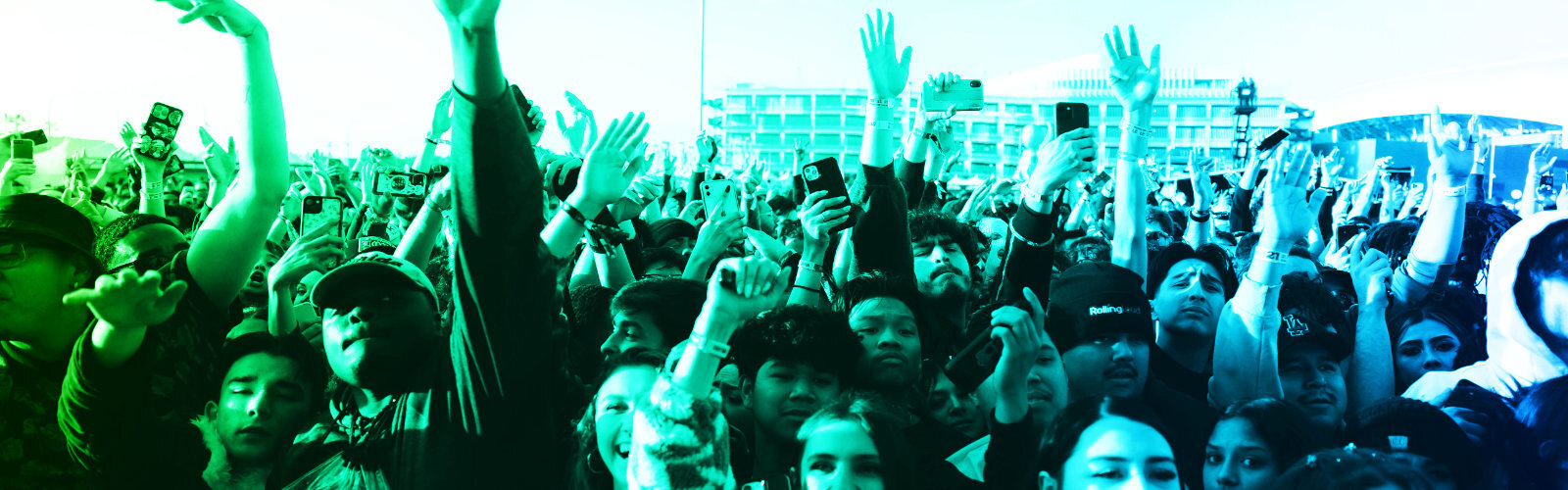
During the NFT boom in music a few years, regular Uproxx readers might have noticed that I’ve always been a bit skeptical of the things. As popular as NFTs became in the recording industry, some of the products being offered up felt more like ways to extract money from invested fans without offering anything much of value. The Bored Apes, the artist profiles on DSPs, the “collectibles” that vanished into thin air as the exchanges hosting the various blockchains supporting them folded or crashed… they all seemed to justify initial skepticism — and that of some of the artists who were being asked to join the party.
However, there was one brand whose offering was intriguing — and seemed to actually give its holders something in the way of value. Rolling Loud, the traveling festival that blew up out of the Miami underground and rapidly expanded to outposts as far-flung as Toronto, Portugal, Thailand, and more, tried something a little different. Its Loudpunx NFTs were billed on the company’s website as “VIP passes to all future Rolling Loud festivals.” Fans could only cop them with Ethereum, but holding them grants access not just to the festivals but also to special VIP lounges and other exclusives within the festival.
As Rolling Loud co-founder Tariq Cherif noted via Zoom, the program has been successful so far largely because of the cutting-edge nature of hip-hop culture itself. With fans of Rolling Loud already among blockchain enthusiasts — hip-hop fans more likely to adopt and adapt to new trends — there was already a market for the product. But fans are also getting their cryptocurrency’s worth with Loudpunx. Cherif says this is only the beginning, and there’s much more to come.
How did the opportunity to create the Loudpunx platform and Loudpunx NFT concept come up, from conception to execution?
In 2018, I start getting into buying crypto. I started with Bitcoin, and then later, Ethereum, and then later, some Altcoins. I wish I got into crypto when I first heard about it in 2009 or 2011. I don’t remember what year it was, but it was when it was a dollar for a Bitcoin. But someone pitched it to me that the use case was, “Oh, you can buy drugs on the Silk Road,” and I was like, “Well, I don’t need or want to buy drugs online, so I don’t need this digital currency.”
I found out about it from that movie Dope, and I was like, “Oh, yeah. That makes sense,” but it just never occurred to me that people would do a stock exchange on it. Like, “Oh, yeah. Dang, dang.”
Fast-forward to 2020, Bitcoin got pretty low. I bought some more Bitcoin in March 2020, and then I start seeing NFTs in 2020, and I’m like, “Oh, this is cool.” Then I see NBA Top Shot, and I’m like, “Oh, this is really cool.” I originally was going to try to rush out Rolling Loud’s version of an NBA Top Shot. It was going to be randomized packs of moments iconic to Rolling Loud history, so you buy a pack and then have different levels of rarity moments in the pack. But I started working on that, and I realized I shouldn’t rush that out. I should really put my head down with our team and figure out what we can do.
Prior to the NFT boom, I had been just playing in my head, and doodling on whiteboards and pieces of paper, trying to figure out how we could best create a loyalty program for our fans. I was studying credit card companies and airlines, and just trying to figure out, “How do we create some type of point system or reward system with tiered gold, silver, bronze?”
I started seeing more and more people in NFTs talking about utility, and what you can do for holders that hold an NFT. That’s when it really clicked, like, “Oh, we should create our loyalty program,” or at least one of our current loyalty programs. I’m sure we’ll do other things in the future, but our current loyalty program is this Loudpunx thing. We started working on it, and we took our time. We took so much of our time that we ended up dropping it after the bull market of NFTs, but I kind of like that, because I don’t want us to be perceived as a cash grab or anything like that.
Why were NFTs the right way to go for your loyalty program?
At the end of the day, we don’t need to sell NFTs. We do perfectly well selling concert tickets, festival tickets in a Web 2.0 Way, but the main purpose of the Loudpunx project is to provide that value to our core fans. One of the biggest drivers of this is that I would see, and my team would see, tweets and Instagram posts and Instagram comments, and DMs and whatnot, like, “I’m going to my 10th Rolling Loud,” or, “I’m going to my third Rolling Loud this year.” As in, they went to three in one year. There’s probably a few thousand people that go to a lot of Rolling Louds. Most fans probably go to one Rolling Loud a year, but there’s some fans that literally fly around the world with us, and I was like, “That’s cool. We should give these people something.”
That’s what this Loudpunx project is. One purchase and boom, you’re locked in. You can go to every Rolling Loud for life, VIP, access to the exclusive Loudpunx lounge within VIP, and just have a great time. It’s easier on your pocket, and when you’re done with it, you’re free to sell it. We love the frictionless nature of Web 3.0. You could do a Web 2.0 solution for a lifetime pass, but then your name would be attached to it. Then if you were done with it, and you wanted to sell it, it would just be a hassle. Whereas harnessing the technology of Web 3.0, it’s just like boom. You buy, it’s yours. Boom, you don’t want it anymore? You sell it, it’s gone.
How has the response from Loudpunx’s users been? What have they said about the program, and how has that worked out for them so far?
It’s been overwhelmingly positive. We’ve had great turnouts. We sold just over 2,000 of these Loudpunx, and about 800 of them came to the LA Show, and 300 and something of them came to the Thailand show. I’m expecting a good amount of them to come to the Miami show this summer, and a decent amount of them to come to our Europe show this summer. The usage of it is high, as far as taking advantage of the utility. The biggest thing I see from our holders is, “Oh, this is the best utility in Web 3.0. I’m actually getting something, and I can redeem it on a consistent basis.” I don’t remember if it was January or February, but we launched Q1, and within Q1, we gave that utility immediately in our first festival of the year in LA.
As far as the challenges of executing something like this, what have they been and how have you overcome them?
I think one of the biggest challenges is with our accounting department wrapping their head around it, government regulation, gray area on how this all needs to work. It’s a little bit wild, wild west. I think that’s been the main challenge, but we got through that. We figured that out, and we’re moving forward.
Do you see yourself, or Rolling Loud, getting involved in advocacy for Web 3.0? Because you’re absolutely right, it’s the wild, wild west. We saw with Ticketmaster, how Congress is starting to get involved. We clearly need new rules and new protections for the spaces, for the artists, for promoters.
We’ll be vocal when it’s merited. We’re fans of Web 3.0, especially when it comes to ticketing. I think that Web 3.0 is great for ticketing, and I think in the future we’ll see more of that. I think Web 3.0 is great for independent artists looking to monetize their craft directly with their fans. I think it’s great for being able to charge royalties, both for promoters like ourselves and for artists.
I think we’ll be as vocal as needed, but we also aren’t some company that’s trying to be out here taking a stand. We are here to represent hip-hop, we’re here to champion hip-hop, and just bring happiness to millions of people while preserving/nurturing hip-hop culture. That’s our mission, and that’s what we’re here to do. Web 3.0 is a tool to help us do that, but our primary focus is promoting hip-hop culture, not promoting Web 3.0, right?
There you go. I always like to ask this question, because as a journalist, I do a lot of interviews. I have to ask a lot of the same questions, and I know my subjects maybe get a little tired of hearing and having to answer the same questions, so this is me inviting you to compose your own question for yourself. Something that you’ve always wanted to talk about that you never get to talk about.
I’d say the biggest misconception about Rolling Loud from people that haven’t been here with us from the beginning is that we’re opportunists, is that we’re Culture Vultures. I would just say, if you look around, what exists now didn’t exist when we started. We started promoting hip-hop shows in Florida in 2010. Nobody was booking at the scale that we are. Rock The Bells had gone out of business, and they were at the golden era of hip-hop festivals. They weren’t dabbling with the new school, nobody was dabbling with the new school.
We were there early, we were nurturing artists early. We started in 100-cap rooms, 200-cap rooms. We cut our teeth doing so many small shows and building relationships with artists. We’re just a part of building this scene up. That’s the biggest thing I would like people to know: We helped build this, and we’re still working on building this and maintaining it and nurturing it, and trying to make it the best that it can be. Because at the end of the day, we’re fans.
We love this music. We love what hip-hop represents. The lyrical element, the social commentary element, the fun element, the trend-setting culture element. We love all of that, and we love to push that forward. We’ve been here for a long time doing it, and we’re excited to keep it going.
source https://uproxx.com/music/rolling-loud-loundpunx-interview-tariq-cherif/
Comments
Post a Comment