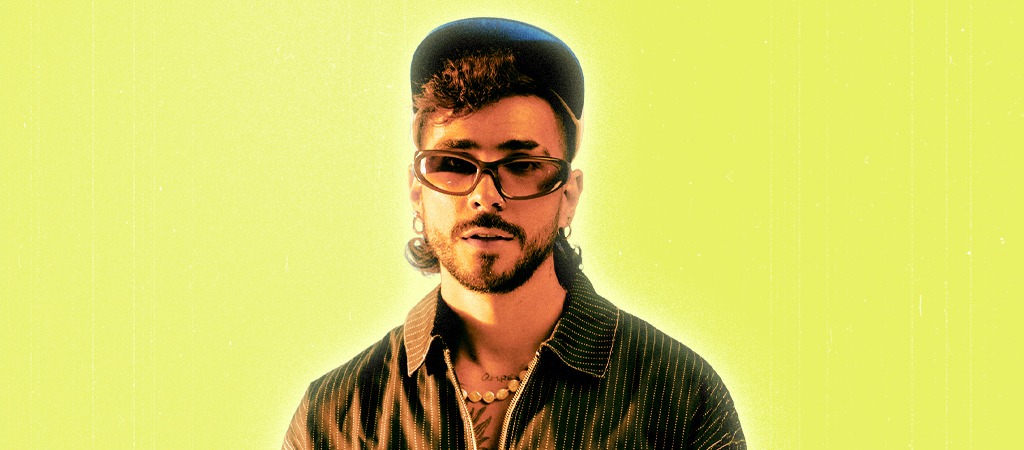
Following a breakthrough year with the smash hit “Solcito,” the future is looking even brighter for Juan Duque. The Colombian heartthrob has positioned himself as the next global pop star with his soulful and sentimental songs that transcend genre. At the same time, Duque is showing a different side to his country with his roots in the small town of Marinilla. His humble beginnings are the foundation on which he’s building his path towards superstardom.
“I owe being a hard worker, responsible, and not being afraid of anything to growing up in Marinilla,” Duque says. “The people here are go-getters. If I’m adding my grain of sand in bringing more visibility to Marinilla, I’m very happy because you’re going to get to know another type of culture, philosophy, and people here.”
In the past decade, Medellín has become the reggaeton capital of Colombia with the success of artists like J Balvin, Maluma, Karol G, Feid, and Ryan Castro. On the outskirts of the city lies Duque’s countryside hometown of Marinilla. Looking to the aforementioned acts as inspirations, he started out as an independent artist five years ago. Duque eventually won over Colombia with his romantic reggaeton hits like “Maria” and the remix of the song featuring Castro. Since signing with Warner Music Latina in 2024, he has also branched out into genres like pop in “Lejos De Mis Ojos” and bachata in “Ni Con Él, Ni Conmigo” while making strides in reggaeton.
Where Duque is making the waves is in the emerging Latin Afrobeats scene. Alongside Miguel Bueno, he scored one of the biggest hits in the genre with their collaboration “Solcito,” which has over 174 million streams on Spotify. Duque is teasing his second album with the Afrobeats-infused hits “Ojalá” featuring Nanpa Básico and “Un Afrito.” As his music grows on an international level, he’s gotten co-signs from J Balvin and Coldplay’s Chris Martin. While in Marinilla, Duque spoke with UPROXX about his upbringing, making music that feels true to him, and his vision for 2026.
How do you feel that more people are getting to know about Marinilla through your success?
More than representing my town, it’s about representing the values, culture, and my roots from here. I wasn’t raised in a big city or the hood, so I didn’t know about things from those regions. I grew up with things typical of life in the countryside. I know what it’s like to live in the mountains and work on a farm while learning about nature, the animals, and cultivation. I love that people seeing that I’m from Marinilla are seeing that the people from here are nice, noble, humble, and hardworking.
Speaking of success, how would you describe this past year in your music career?
It was a beautiful year. It was a year with a lot of growth in my career. I’m happy that I’ve gotten to travel to many different countries, especially thanks to the success of “Solcito.” That song opened many doors for us internationally. It put us in front of so many people and I was able to do my first international tour. I’m grateful for everything that happened last year.
How did the song “Solcito” come together with Miguel Bueno?
I want to keep following my instincts because they’ve been very on-point. Miguel and I were working on another song. The day that we met in the studio to finish up that other song, I had already developed “Solcito.” I was listening to it on the way to the studio. When I got there, I told them, “Forgive me, but we should do ‘Solcito’ instead.” They were telling me the other song was almost done and that they had to turn it in. I said, “We have to work on ‘Solcito.’ Believe me, it’s very good.” Miguel liked it and he told me, “You’re crazy, but I believe you, so let’s go ahead with this one.” Then “Solcito” came out and it was beautiful to see how things turn out when you follow your intuition without knowing what will happen or giving in.
Afrobeats have become the new frontier in Latin music. In addition to “Solcito,” you now have songs like “Ojalá” and “Un Afrito.” Where did the idea come from to explore Afrobeats?
I love the Afrobeats genre for one reason and that’s how it brings me back to beautiful moments and memories on the beach. I love to spend time in the Caribbean. With the whole Afrobeats wave last year, I loved it because I knew that I would have music that’s perfect for the beach. I love to listen to and feel the Afrobeats vibes. This past year, I wanted to transmit those happy and feel-good vibes in my music. It’s a genre with a lot of soul and that’s why I’m exploring it because I enjoy how that feels.
In addition to Afrobeats, you also have songs that explore genres like reggaeton, pop, and bachata. Why is it important for you to branch out to other genres?
I’m having fun. If I explore a different genre, it’s for fun. It’s because I like it and it’s something that I want to do. I’m never thinking about what’s trending. If I don’t feel it, I don’t do it. I don’t define the sound of my music because if I define it, I’m limiting myself. I’m an artist that sings about the vibes that I want to feel. I express what I feel independent of any genre. I make music for people that like and enjoy a bit of everything.
In the remix music video for “Maria,” I love how you include same-sex couples in the mix. As an ally, why was it important for you to normalize LGBTQ+ relationships in that video?
That was very beautiful because I don’t think there was a reggaeton music video with that kind of inclusion before. I liked doing that because I showed people in reggaeton that we can have videos with those kinds of relationships too. Above all, everyone can relate to the song “Maria.” That song expresses love in all its forms. The remix video broke down barriers for love. It was beautiful to show love exactly as it is. I love and support the LGBTQ+ community like they support me. I make music for everyone.
From your charisma, your lyrics, and your body, you have fans that see you as a sex symbol. How do you feel to be seen in that way?
It’s nice to get compliments, but I don’t see myself that way. When I started my career a few years ago, I wanted to hide that part of me. I didn’t want to be seen in that way or have my image be what stands out. My fans made me realize that it’s okay to show who I am and not hide myself anymore. If I want to appear shirtless in a music video or take off my shirt during a concert, I’ll do it. They told me to show who I am because people like that. Now I’m like, “Go for it! Fantasize about me if you want to. Enjoy it!” [Laughs.] It’s beautiful that they care about me in that way, and above all, have shown me that it’s my music that makes me stand out.
You’ve hung out with J Balvin a few times. What does it mean for you to have the support of one of Colombia’s biggest artists?
More than on an artist level, he’s given me support on a human level. Jose [J Balvin] has given me so much valuable advice about my life and my career. I love to get advice from people that I admire. He’s a close friend of mine because I can talk with him when I need to. It doesn’t matter if we collaborate or work together. What matters is that I can talk with him when I need something or have a question. When I need advice, I can talk or text with him. It’s a blessing to have access to a person like Jose. If you ask me about my biggest dream collaboration, I would say J Balvin.
What was the experience like when you got to hang out with Coldplay’s Chris Martin?
That was very crazy and surreal. I never imagined to be sitting down and talking with an artist like him or a human being that’s so connected to life. To sit down with him felt like a bit of his energy rubbed off on me. We talked about life, our roots, and emotions. I showed him my song “Ojalá” with Nanpa Básico and he told me, “That song is already a hit.” I told him that the song hadn’t been out for 24 hours and he said, “You’re going to remember me telling you that this song is a hit.” Five months later and that song has become massive in Colombia. People have dedicated that song to their partners and even gotten married to it. Chris Martin heard that song, gave it his blessing, and so many things have happened with it.
Now that you’ve toured much of Latin America and Spain, is there a chance that you will do shows in the US next?
Yes, because now I have my work visa. Now it’s time to go to the US and visit the most cities that I can. This past year, I was waiting on my work visa to get a US tour together. I know there’s a lot of people there asking me to perform for them. We’re going to see each other soon.
What can we expect from you in 2026?
There’s a lot of music coming that people can enjoy. I’m feeling very prolific as an artist and I’m taking advantage of this moment. Almost everyday I’m going to the studio, including the holidays, to make music. Right now I’m focused on having fun with what I’m doing and being free to make the music that I want to make.
source https://uproxx.com/music/juan-duque-is-building-colombias-next-global-pop-moment/
Comments
Post a Comment