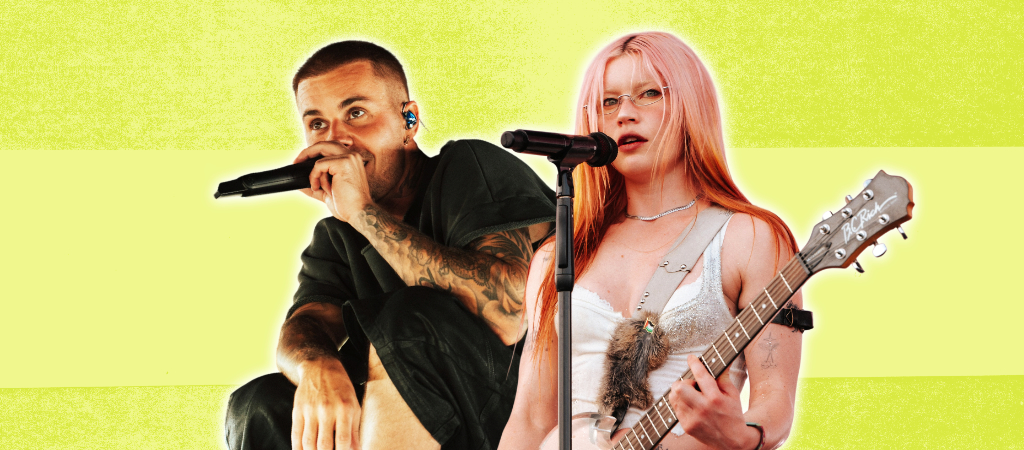
The first weekend of Coachella 2026 is over. It was quite the three days out in the desert, too. Pop stars made head-turning creative choices, rock favorites brought boundless energy, and icons continued to innovate. Consequently, there were so many great sets and individual moments worth looking back on. The weather offered some scares, but ultimately, the festival will be remembered by the highlights. So far, after just one weekend, Coachella has proven there’s so much to love about the never-boring contemporary music landscape.
Turnstile
Turnstile’s big moment came at a sensitive time for the band: Earlier this month, Brady Ebert, the band’s former guitarist, was arrested on charges of attempted second-degree murder and first-degree assault of Bill Yates, the father of lead singer Brendan Yates. At the start of their set, the band played a set of pre-recorded videos, one of which was from the elder Yates, which got some big cheers from the audience. Once the show got going, it boasted the classic Turnstile intensity, complete with a mosh pit, Brendan crowd-surfing, and favorites like “Never Enough” and “Blackout.”
Not For Radio
After a long day trudging across festival grounds in the hot sun, it’s a big ask to show up to a late-night set. It’s not nearly as bad, though, when you’re staying up for Not For Radio, the solo project of The Marías’ María Zardoya. She went on at around midnight on Friday, but her gorgeous sleepy-hours performance was worth pushing the limits of fatigue. Aside from Zardoya just being generally fantastic, fans were treated to the live debut of an unreleased song. It was all part of a stunning new performance that Zardoya called “Fireflies After Dark.”
Sabrina Carpenter
A few days before Coachella began, Carpenter stirred up some excitement when she said of her planned performance, “It’s the most ambitious show I’ve ever done,” revealing that she had seven months to work on it. As expected, it was a spectacle. There were appearances from Sam Elliott, Susan Sarandon, Will Ferrell, and Samuel L. Jackson. Jackson helped Carpenter have one of her most memorable “Juno” positions: Instead of pulling a suggestive pose, a Jackson voiceover played, in which he took the audience on a brief meditation before calmly telling Carpenter to “finish the motherf*ckin’ song.” The whole thing was showmanship at its finest.
Geese
Geese have been crushing it with live covers lately, nailing New Radicals’ “You Get What You Give” in the BBC Radio 1 Live Lounge a few months ago. They were at it again at Coachella this past weekend, though they went with a more contemporary cut: While performing their own “2122,” they threw in a snippet of Justin Bieber’s “Baby,” presumably as a nod to Bieber headlining the fest. Did anybody see this coming? No, but was it awesome? It was Geese, so yes, absolutely. The Geese hype was real, even luring Carpenter to check out the set from the audience.
Nine Inch Noize
Nine Inch Nails have welcomed a new collaborator into their creative universe: Boys Noize, who remixed Trent Reznor and Atticus Ross Challengers soundtrack, worked on to NIN’s Tron: Ares soundtrack, and was an opener on their Peel It Back Tour. Now he’s part of the crew, as he joined Reznor and Ross in a new supergroup, Nine Inch Noize. They made their big debut at Coachella. It wasn’t completely clear what they would end up doing together, although the most expected possibility turned out to be it: On the aforementioned tour, Boys Noize remixed a bunch of NIN songs, and their fantastic joint set this past weekend was full of masterful re-workings.
PinkPantheress
PinkPantheress went heavy on the collaborators, too: The Dare got his own three-song section of her set, playing new Addison Rae and Charli XCX remixes, along with his own “Girls.” When the spotlight returned to PinkPantheress, she shared it with Thundercat, who brought his otherworldly bass dexterity as Pink sang “Break It Off.” PinkPantheress nailed it overall, continuing to shine when she didn’t have performance partners to give her a boost. She’s come a long way from the production-minded artist whose view of performing live was fueled by fear.
Justin Bieber
Bieber was perhaps the biggest star in the desert last weekend, but his set was one of the most divisive. For the back half of it, he had a laptop hooked up to a giant screen behind him, playing his own old videos as he sang along to his back catalog. At one point, he even went ahead and just watched the “deez nuts” meme. Some called it lazy, but one thing nobody could rightfully label it was forgettable. Having a YouTube watch party on stage at the biggest festival in the world is a big swing, but it’s one that paid off as the headlining set turned into a fun, casual, nostalgia-fueled hang. As Zara Larsson put it, “It’s giving let’s smoke and watch YouTube,” but that wasn’t a bad thing.
Sombr
Sombr is more of a rock fan that some people might realize. He’s big on classic UK bands, he played a great cover of The Cranberries’ “Linger” last month, and he led with rock once again at Coachella. His performance was highlighted by bringing Billy Corgan on stage for “1979.” Sombr played his part perfectly, too, letting Corgan belt out the iconic first line of the chorus, “And I don’t even care, to shake these zipper blues,” as only he can with his distinct voice. Sombr’s a wonderful performer, but it was endearing to see him just be a fan, too.
Wet Leg
Wet Leg already have plenty of social currency among rock icons, like Dave Grohl, who joined them on stage at Coachella back in 2023. Their profile has only increased since then, and they’ve only gotten better. Their late-afternoon set was full of energy and charm, and even a surprise appearance from Horsegiirl. For attendees who missed them this time, they shouldn’t repeat the mistake this coming weekend.
FKA Twigs
More than most of her contemporaries, Twigs is a charismatic and high-effort performer. Remember when she got really good at pole dancing just for one video? She never phones it in, both with the music and her choreography, which would be impressive even if she wasn’t also singing through it. She brought back her pole-dancing prowess for a particularly moving rendition of “Cellophane,” and it was a striking way to put a bow on Weekend 1.
source https://uproxx.com/music/coachella-2026-weekend-one-justin-bieber-wet-leg/
Comments
Post a Comment